
Capturing the Colors and Shadows of Street Corners at 50mm
When you take photos in the city, it is not only famous buildings and tidy scenery that catch your eye.
Faded signs, traffic cones left on the sidewalk, the shadow cast by a passerby. Even familiar things take on a different expression when you point a lens at them.
This is a review of street-corner snapshots taken with the combination of the Leica M (Typ 240) and the SUMMICRON-M 50mm f/2 E39 3rd generation.
Through the sample photos, we look at the colors, sense of distance, and light and shadow captured by the 50mm angle of view.

Capturing Everyday Life with the Leica M (Typ 240) and the 3rd-Generation SUMMICRON
The Leica M (Typ 240) is a digital camera with an optical rangefinder. While retaining the very M-series Leica mechanism of the photographer focusing manually, it also supports live view.
The 3rd-generation SUMMICRON-M 50mm f/2 we paired it with is a Leica M-mount prime lens manufactured from 1969 to 1979.
With the 50mm used here, the impression of the photo changes depending on where you stand: step back when you want to take in more, step closer when you want to show detail.
Being able to record today's city by combining a digital body and a lens from different eras is another interesting aspect of the M system.
An In-Focus Sign and a Blurred Streetscape
The first shot is a striking red and yellow "No Abandoned Bicycles Zone" warning sign.
The eye is drawn to the lettering and rusted metal in the foreground, while the road and buildings behind are heavily blurred. With the background information simplified, a sign you would normally walk past becomes the star of the photo.

A red and yellow warning sign. The streetscape behind is blurred, making the lettering and metal texture stand out.
An old sign reading "No Parking" is another sample that brings a similar discovery.
While the peeling paint and rusted post are visible, the shop interior behind is softly blurred. The vivid blue wall on the right and the red cone in the foreground add accents of color to the frame.

The texture of a well-worn sign and its color contrast with the blue wall.
Both are good examples of how the distance between subject and background shapes the impression of the frame.
With this lens, usable wide open at f/2, there is pleasure in thinking about how to show the background by changing where you focus and the aperture.
Yellow, Red, Green: Compositions Made from the Colors of the City
A fallen yellow guide device and scattered red cones.
In this sample, the not-so-orderly state of the street is shown with vivid colors and diagonal lines.
The yellow object cuts across the center of the frame, and the red of the cones carries the eye around it. Even the green road surface and white lines become part of the composition.

A yellow guide device and red cones. The green pavement and white lines set off the vivid colors.
In another photo, a large red cone stands in the foreground, with blue cleaning tools and a closed shutter lined up behind it.
Not only the arrangement of the objects but also the size of the cone and the smallness of the tools behind convey the distance between front and back.

A cone and cleaning tools placed in an alley. The arrangement of foreground and background conveys depth.
In the photo of a construction fence, yellow and red cones repeat from front to back, and the green fence takes up that rhythm.
The composition, with the foreground blurred and the eye drawn to the fence behind, is also striking.
Even without searching for special subjects, the combinations of colors and lines found in the city become photographs.

Repeating cones and fences. A street-corner scene where color and perspective overlap.
The Relationship Between People and the City Found in 50mm Snapshots
In the lottery booth sample, a person reaching toward the central window and the people sitting on either side are contained within a single frame.
What is interesting is how people spending their own separate time appear side by side, centered on the small booth.
Pedestrians and the street in the background also appear, preserving a sense of the city as a whole.

Capturing people each spending their own time around a lottery booth.
A shot taken from behind of a child in yellow and an adult with an arm around their shoulder is captured from a much closer distance.
Because the two figures occupy much of the frame, the surrounding traffic recedes into the background, and the movement of the arm and the color of the clothes catch the eye.

A shot where the yellow clothing draws the eye. The two figures are captured large, with the surrounding streetscape receding into the background.
Even with the same 50mm, depending on the distance to the subject and how much background you include, a photo can convey a place or center on a person's gestures.
The Shapes of Light and Shadow Revealed in Black and White
In the color photos, the colors of signs and clothing drew the eye, but in black and white, light and dark and form come more to the fore.
In the photo of a person walking, the shadow stretching long across the ground is a second star.
The movement of the feet and the direction of the shadow preserve a moment of motion in a still image.

A walker's feet and the shadow stretching across the ground. The direction of light determines the impression of the frame.
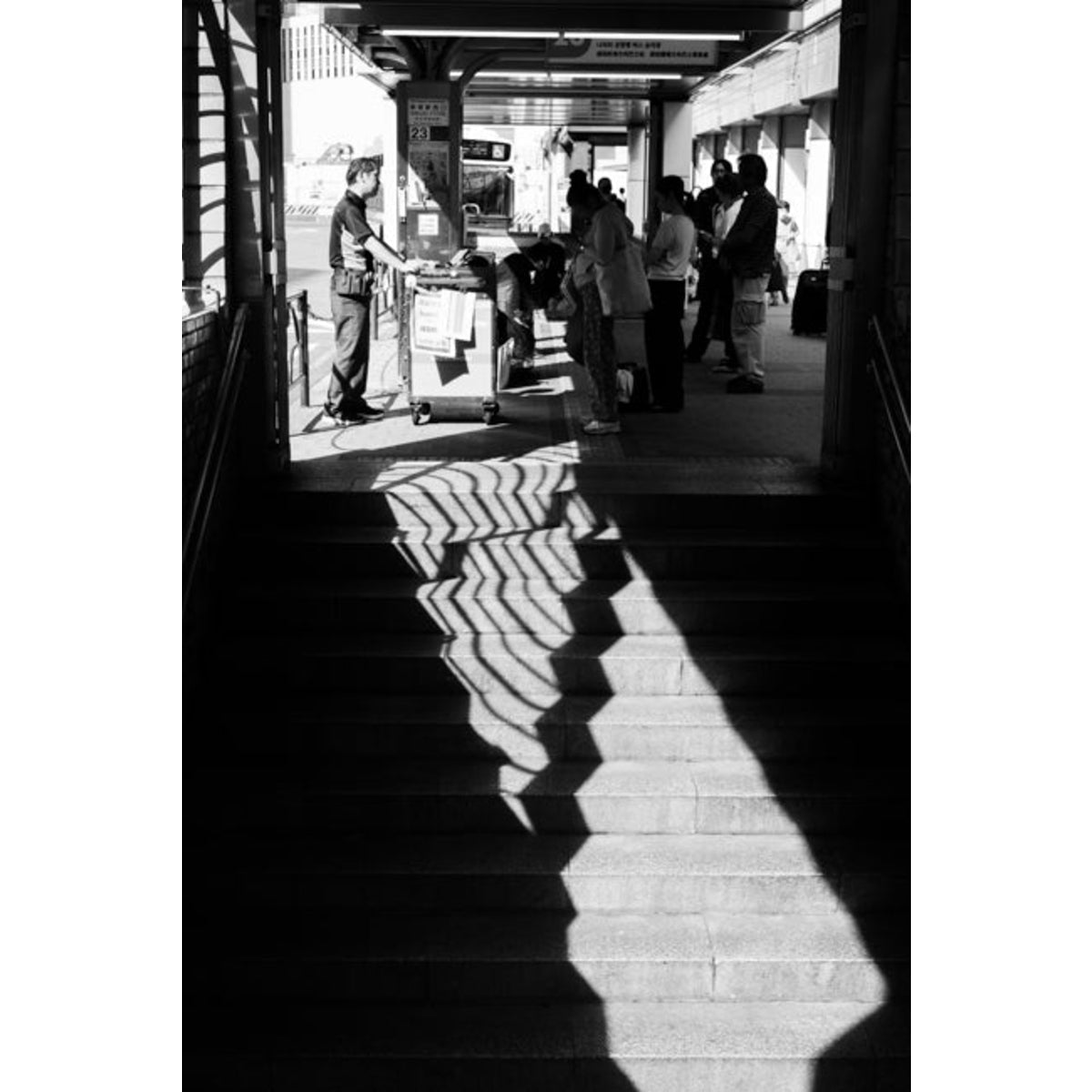
In a vertical shot of a staircase, the diagonal shadows of the handrail continue into the depth of the frame.
The bright floor, the dark passage and the silhouettes of distant people overlap, creating a sense of depth.
It makes you realize that even without color, the city holds many elements that make photographs.

Regular shadows falling on the stairs and the silhouettes of people. The vertical composition emphasizes depth.
The Time Spent Focusing Is Also Part of the Photograph
With this combination, you shoot by focusing manually rather than with autofocus.
On the M (Typ 240), in addition to aligning the images in the optical viewfinder, you can also use live view magnification and focus peaking.
Focus peaking is an assist function that makes it easier to see on screen which parts are in focus.
For example, if you want the lettering on a sign to be the star, focus on that lettering; if you want to show a person together with their shadow, pay attention to the positional relationship between the two.
These sample photos also prompt you to think not only about where to place focus but about what to leave in the frame.
A Combination That Slightly Changes the Way You See the City as You Walk
The sample photos here are not all taken at special photo spots.
Well-worn signs, devices by the roadside, the casual movements of people, shadows falling on the ground. When you capture them at 50mm, your eye naturally turns to these small parts of everyday life.
The Leica M (Typ 240) and the 3rd-generation SUMMICRON-M 50mm f/2 are equipment that let you combine the recording capability of digital with a shooting style in which you choose focus and composition by hand.
The next time you walk through the city, you will want to look at the colors and shapes you would usually overlook.
About the Leica M (Typ 240)
A digital rangefinder camera announced in 2012 and released in 2013.
It features a 35mm full-frame CMOS sensor with approximately 24 effective megapixels and supports Leica M-mount interchangeable lenses.
It uses manual focus with an optical rangefinder. You focus on the subject by aligning the images in the viewfinder.
It also supports live view shooting using the 3.0-inch rear LCD monitor. You can check focus using magnification and focus peaking.
It supports shutter speeds up to 1/4000 sec, and also has aperture-priority AE and Full HD video recording.
Width × Height × Depth: Approx. 138.6mm × 80mm × 42mm
Weight: Approx. 680g (including battery, excluding lens)
About the Leica SUMMICRON-M 50mm f/2 E39 3rd Generation (11817)
A manual focus prime lens for Leica M mount, introduced in 1969 and manufactured until 1979.
A standard lens with a 50mm focal length and an f/2 maximum aperture, with a 39mm (E39) filter size. The product number is 11817.
The optical system consists of 6 elements in 5 groups, and the minimum focusing distance is 0.7m. Focus and aperture are set manually by operating the distance ring and aperture ring.
It has a black-finished barrel and a separate lens hood. Its optical construction and barrel design differ from later models, giving it its own distinctive character in the history of the SUMMICRON-M 50mm.
See the M Typ 240 listings here
See the SUMMICRON-M 50mm f/2 E39 3rd Generation listings here
If you are looking for a used camera or lens, leave it to Five Star Camera.
We not only sell but also buy cameras and lenses.
At both our Shinjuku and Toyama stores, you can check products in person before purchasing. We also carefully appraise each item one by one when buying. Please feel free to contact us.